

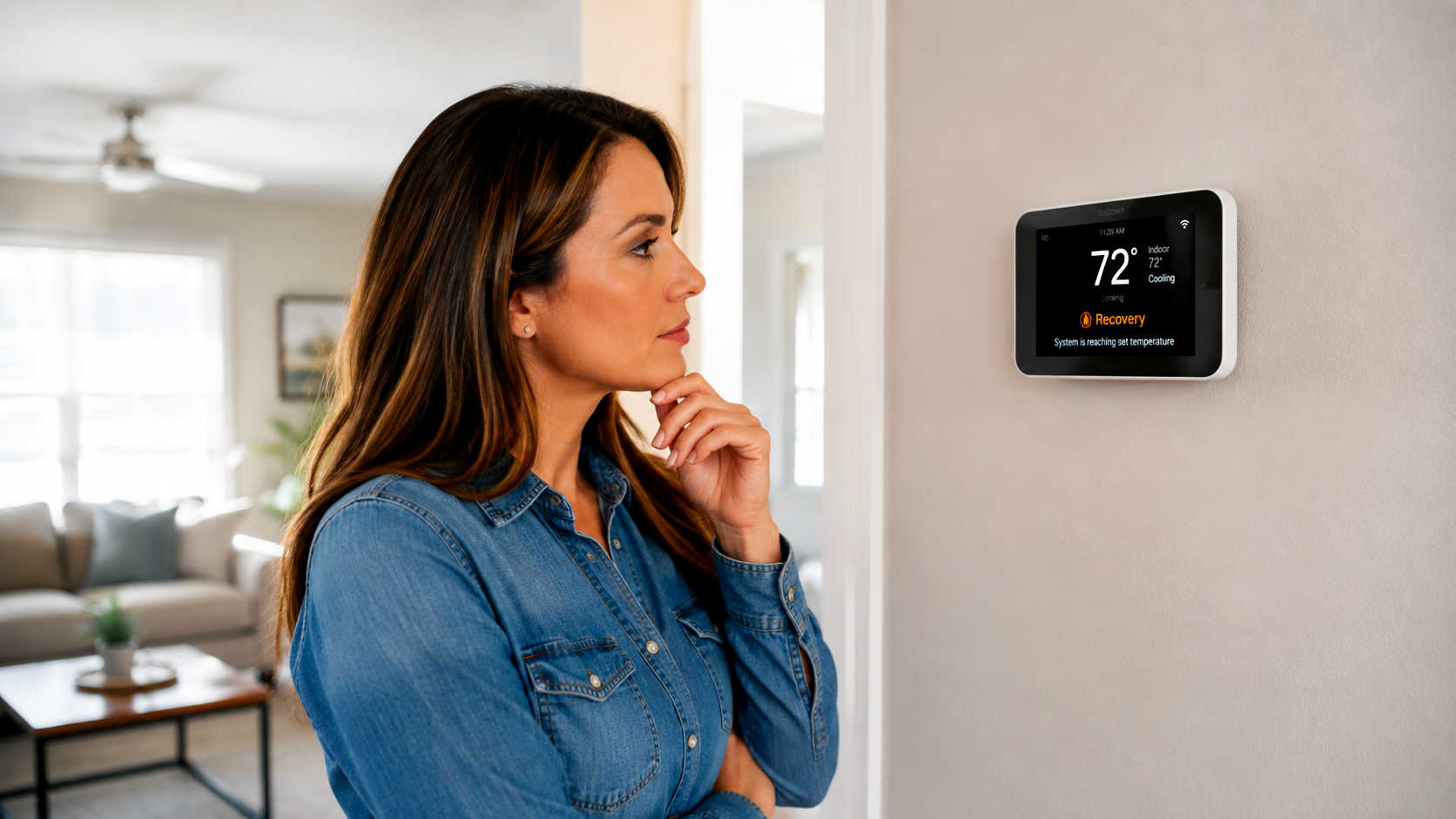
Seeing the word “Recovery” on your thermostat can be confusing, especially if your heating or cooling system seems to be running before the temperature change you scheduled.
In most cases, thermostat recovery mode is a normal smart-thermostat feature designed to help your home reach the temperature you want at the time you want it. Instead of waiting until the scheduled time to start heating or cooling, the thermostat begins adjusting the temperature in advance.
For homeowners in Amarillo, TX, where outdoor temperatures can change quickly, recovery mode can help a heating or cooling system reach the desired indoor temperature more gradually and efficiently.
However, if your thermostat stays in recovery mode for unusually long periods, enters recovery mode unexpectedly, or your HVAC system cannot reach the set temperature, there may be another issue that needs attention.
What Is Recovery Mode on a Thermostat?
Thermostat recovery mode is a feature found on many programmable and smart thermostats. It allows the thermostat to begin heating or cooling your home before a scheduled temperature change.
For example, suppose your thermostat is programmed to reach 72°F by 6:30 a.m. Instead of turning the system on at exactly 6:30, the thermostat may begin heating at 6:00 or even earlier.
The goal is for your home to already be at the desired temperature when the scheduled time arrives.
That is why seeing “Recovery” on the display does not necessarily mean the thermostat is malfunctioning.
Why Is My Thermostat in Recovery Mode?
There are several common reasons a thermostat may enter recovery mode.
1. Your Thermostat Is Preparing for a Scheduled Temperature
This is the most common reason.
Smart thermostats often calculate how long your HVAC system needs to reach the next scheduled temperature and begin operating ahead of time.
The thermostat may consider factors such as:
Outdoor temperature
Current indoor temperature
Desired indoor temperature
How quickly your HVAC system typically heats or cools the home
Previous system performance
If your thermostat enters recovery mode shortly before a scheduled temperature change, it is usually operating normally.
2. Your Thermostat Is Learning Your Home
Many modern thermostats include learning and scheduling features. ENERGY STAR explains that some smart thermostats learn temperature preferences and automatically establish schedules that adjust heating and cooling settings.
Over time, the thermostat may learn:
How quickly your home heats up
How quickly your home cools down
How outdoor temperatures affect indoor comfort
How long your HVAC system typically needs to reach the set temperature
The thermostat can then adjust its startup time automatically.
This behavior may make recovery mode appear earlier on extremely hot or cold days than it does during mild weather.
3. Amarillo Weather Is Making the System Work Longer
Texas Panhandle weather can have a noticeable effect on recovery time.
Hot summer afternoons, freezing winter mornings, strong winds, and rapid temperature swings can all increase the amount of time your HVAC system needs to reach the desired indoor temperature.
For example, if your home cooled significantly overnight and the thermostat is programmed to raise the temperature early in the morning, recovery mode may begin sooner during a cold front.
Likewise, during extreme summer heat, the thermostat may start cooling earlier to reach the scheduled temperature.
4. Your Thermostat Is Trying to Improve Efficiency
Recovery mode is designed to allow the HVAC system to reach the desired temperature gradually rather than making a sudden large adjustment at the scheduled time.
For some systems, this can help reduce abrupt temperature swings and improve comfort.
Rather than waiting until your scheduled setting begins and then running aggressively, the thermostat attempts to anticipate the change.
How Long Does Thermostat Recovery Mode Last?
There is no single amount of time that recovery mode should last.
The duration depends on factors such as:
The difference between the current temperature and the scheduled temperature
Outdoor weather conditions
The size and efficiency of the HVAC system
The home’s insulation
Airflow through the system
How quickly the home normally heats or cools
Thermostat programming
A recovery period lasting 20 to 60 minutes may be completely normal in many situations.
During extreme Amarillo weather, however, recovery mode may begin even earlier.
The important question is whether the system eventually reaches the scheduled temperature.
How to Get a Thermostat Out of Recovery Mode
If you want to know how to get your thermostat out of recovery mode, the first thing to understand is that recovery mode often ends automatically once the scheduled temperature is reached.
If you want to exit it sooner, you may be able to:
Adjust the thermostat to a different temperature
Cancel or modify the programmed schedule
Temporarily place the thermostat in a hold mode
Disable adaptive recovery or smart recovery in the thermostat settings
The exact steps vary by thermostat manufacturer and model.
Before changing any advanced settings, check the thermostat’s manual or manufacturer instructions.
Can I Override Recovery Mode on My Thermostat?
In many cases, yes.
Most programmable and smart thermostats allow you to temporarily override the scheduled temperature.
Depending on the thermostat, you may see options such as:
Hold
Temporary Hold
Permanent Hold
Schedule Off
Manual Mode
Changing the temperature manually may temporarily override recovery mode until the next programmed schedule begins.
Some thermostats also allow you to disable the recovery feature completely.
However, turning recovery mode off means the system may not begin heating or cooling until the scheduled time itself. That can cause the home to take longer to reach your desired temperature.
Is Recovery Mode Normal?
Usually, yes.
Recovery mode is generally considered normal when:
It occurs shortly before a scheduled temperature change
The system eventually reaches the desired temperature
Heating and cooling performance otherwise seems normal
The thermostat exits recovery mode once the target temperature is reached
It may be worth investigating if recovery mode becomes constant or appears alongside other HVAC problems.
When Thermostat Recovery Mode May Indicate a Problem
Recovery mode itself is not usually a warning sign, but unusually long recovery periods can sometimes reveal an HVAC performance issue.
Possible concerns include:
Dirty Air Filter
A clogged filter can restrict airflow and make it harder for the HVAC system to reach the set temperature.
As a result, recovery mode may last longer than expected.
Restricted Airflow
Closed vents, blocked return grilles, dirty coils, or duct problems can reduce system performance.
Poor airflow can make both heating and cooling take longer.
Incorrect Thermostat Settings
An incorrect schedule, temperature setting, or thermostat mode can cause unexpected recovery behavior.
Check that the thermostat is set to the correct:
Heating or cooling mode
Schedule
Time
Day
Temperature
Thermostat Placement
A thermostat located near a draft, exterior door, direct sunlight, kitchen, or supply vent may detect temperatures that do not accurately represent the rest of the home.
That can affect when recovery mode starts and how long it lasts.
Aging HVAC Equipment
Older heating and cooling equipment may take longer to reach the desired temperature.
If recovery periods are becoming noticeably longer than they used to be, declining system performance may be contributing.
HVAC System Problems
Long recovery periods may also be associated with:
Low refrigerant
Dirty evaporator or condenser coils
Blower motor problems
Furnace heating problems
Heat pump performance issues
Electrical or control problems
These problems require professional diagnosis.
If the problem extends beyond thermostat programming, professional HVAC repair in Amarillo can identify airflow, electrical, heating, cooling, or equipment-performance problems that may be extending recovery time.
Why Is My Thermostat Stuck in Recovery Mode?
If your thermostat appears to stay in recovery mode for hours, first check whether the HVAC system is actually reaching the desired temperature.
A thermostat that never exits recovery mode may be responding to a system that cannot satisfy the temperature setting.
Before scheduling service, you can also review these safe HVAC troubleshooting steps to rule out basic thermostat, filter, airflow, and power issues.
Make sure the thermostat is set correctly
Check the air filter
Confirm supply vents are open
Make sure return-air grilles are not blocked
Check whether the HVAC system is producing warm or cool air
If the temperature does not move toward the set point, the problem may involve the HVAC system rather than the thermostat itself.
Should I Turn Off Recovery Mode?
Not necessarily.
If the feature is working normally, there is usually little reason to disable it.
Recovery mode can help your thermostat anticipate scheduled temperature changes and improve comfort.
You may choose to disable it if:
You prefer the system to start exactly at scheduled times
Your daily routine changes frequently
You do not use thermostat scheduling
You prefer manual temperature control
Before disabling the feature, make sure the behavior you are seeing is actually normal recovery mode and not an HVAC system struggling to reach the set temperature.
Does Recovery Mode Mean My HVAC System Is Running Too Much?
Not automatically.
Recovery mode may cause the system to start earlier, but that does not necessarily mean it is operating inefficiently.
The thermostat is intentionally beginning the heating or cooling process before the scheduled time.
The situation becomes more concerning when:
The system runs almost continuously
The indoor temperature never reaches the set point
Energy bills increase significantly
Airflow becomes weak
The system repeatedly starts and stops
The furnace does not produce enough heat
The AC blows warm air
Those symptoms may indicate an HVAC problem that deserves professional inspection.
Thermostat Recovery Mode During Amarillo Summers
During a hot Amarillo summer, your thermostat may begin recovery mode earlier than expected.
If the indoor temperature rose while you were away and your thermostat is programmed to cool the home before you return, the system may need additional time to overcome the heat stored inside the house.
High outdoor temperatures, direct sunlight, insulation quality, and HVAC system condition can all affect how quickly the home cools.
Recovery mode can therefore last longer during extreme heat without necessarily indicating a thermostat failure.
Thermostat Recovery Mode During Amarillo Winters
Cold Texas Panhandle mornings can create a similar situation.
If your thermostat lowers the temperature overnight and is scheduled to warm the house before you wake up, it may begin recovery mode well before the scheduled time.
Heat pumps can be especially affected by outdoor temperatures because their heating capacity changes as temperatures fall.
A longer recovery period during very cold weather can be normal, but a system that cannot reach the set temperature may need professional evaluation.
When Should You Call an HVAC Professional?
Consider scheduling HVAC service when:
The thermostat stays in recovery mode for hours
Your home never reaches the set temperature
Recovery times become noticeably longer than before
The HVAC system runs constantly
The system repeatedly starts and stops
Airflow is weak
The furnace is not heating properly
The AC is not cooling properly
The thermostat display behaves erratically
The system trips a breaker
You hear unusual HVAC noises
There is a burning or electrical odor
A technician can determine whether the issue is related to thermostat programming, thermostat placement, airflow, equipment performance, or another HVAC component.
Thermostat Help in Amarillo, TX
In most cases, thermostat recovery mode is a normal feature that helps your heating or cooling system reach the desired temperature before a scheduled change.
If recovery mode appears at predictable times and your home reaches the correct temperature, the thermostat is probably working as intended.
If your thermostat remains in recovery mode unusually long or your HVAC system struggles to heat or cool your home, Caprock Services Heating & Air can help.
Caprock Services Heating & Air provides professional heating and air conditioning services in Amarillo, TX, including thermostat troubleshooting and HVAC system diagnosis.
Frequently Asked Questions About Thermostat Recovery Mode
What is recovery mode on a thermostat?
Recovery mode is a feature on many programmable and smart thermostats that starts heating or cooling before a scheduled temperature change. Its purpose is to help the home reach the desired temperature by the scheduled time rather than beginning the adjustment at that time.
Why is my thermostat in recovery mode?
Your thermostat may be in recovery mode because it is preparing for an upcoming scheduled temperature, adapting to how quickly your home heats or cools, or accounting for outdoor conditions. In most cases, recovery mode is normal if the HVAC system eventually reaches the desired temperature.
How do I get my thermostat out of recovery mode?
Recovery mode will normally end automatically once the scheduled temperature is reached. Depending on the thermostat, you may also be able to change the temperature, use a temporary hold, modify the schedule, or disable the adaptive recovery feature. Instructions vary by thermostat model.
Can I override recovery mode on my thermostat?
Many programmable and smart thermostats allow recovery mode to be temporarily overridden by changing the set temperature or selecting a hold or manual mode. Some models also allow the recovery feature to be disabled through the thermostat settings.
How long should thermostat recovery mode last?
Recovery time varies depending on the difference between the current and desired temperatures, outdoor weather, HVAC system performance, insulation and airflow. Recovery may begin earlier during very hot or cold Amarillo weather because the HVAC system needs more time to reach the scheduled temperature.
Why is my thermostat stuck in recovery mode?
A thermostat that remains in recovery mode for an unusually long time may be responding to an HVAC system that cannot reach the desired temperature. Dirty filters, restricted airflow, thermostat settings, equipment problems or extreme outdoor temperatures may contribute to longer recovery periods.
When should I call an HVAC professional about recovery mode?
Professional HVAC service may be appropriate when recovery mode lasts for hours, the home never reaches the set temperature, recovery times suddenly become much longer, airflow is weak, the HVAC system runs constantly, breakers trip, or heating and cooling performance declines.
Schedule HVAC Service
If your thermostat is behaving differently than expected or your heating and cooling system cannot keep up with the temperature setting, professional diagnosis can help determine the cause.
Contact Caprock Services Heating & Air to schedule HVAC service in Amarillo, TX and get help with thermostat problems, heating and cooling performance, airflow issues, and other comfort concerns.